

Hi, I’m David! And AI just made my life harder (again).
I don’t know about you, but I’d been watching for months how Google’s search results were changing in the U.S. And not just a little—more like full-on Terminator mode. Instead of the usual links and headlines we’ve always known, Google has decided it’s better to show you a “magical” summary created by AI. Just like that—no warning, no cushion. And now, dear Spanish reader, that “AI-generated overview” has officially arrived here too.
Congratulations! You’re now part of the future— The one where Google becomes that know-it-all cousin who explains everything to you… even though he just read it on Wikipedia three seconds ago.
🤖 What the heck is the “AI-Generated Overview”?
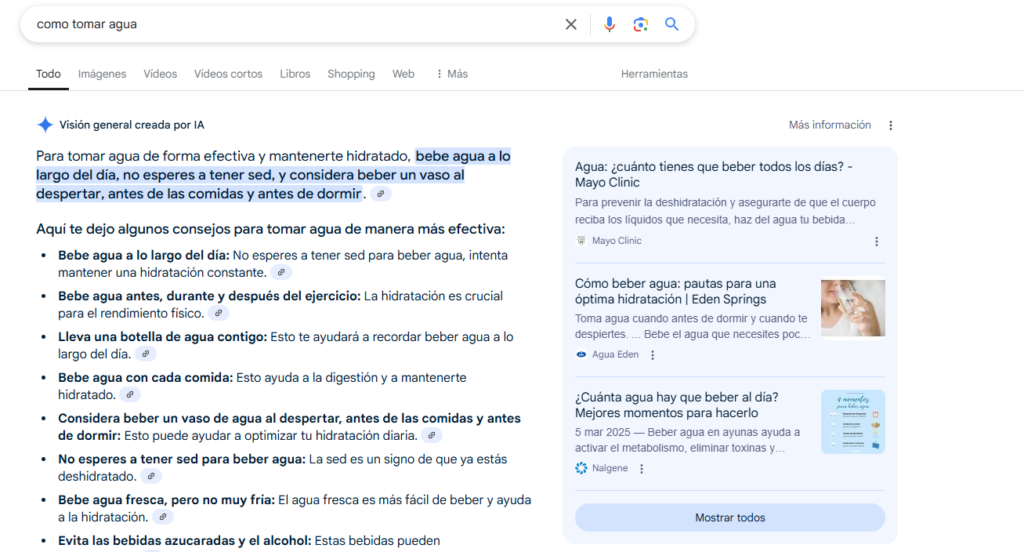
Imagine you Google: “What’s the best way to make gluten-free bread?”. Before, you’d have to check out two or three websites—maybe even a blog run by a lady in Galicia who’s been baking proper bread for over 20 years.
Not anymore. Now Google hits you with something like:
“The best way to make gluten-free bread is by using alternative flours such as rice, corn, or almond. Adding xanthan gum can improve elasticity.”
All of that was written by AI, using content from third parties (yep, people like you and me), and placing it above all the links.
In other words: Google answers for you… without anyone clicking on your website.
💬 «We create content so AI can summarize it. Welcome to algorithmic ghostwriting.»
👵️ «What does this mean for SEO?»
Well, if SEO used to be a roller coaster, now it’s that same roller coaster… on fire.
Google says this only applies to “certain searches” and that the links are still there. But come on—if a user already gets a summarized answer in the first glance, why would they bother clicking?
Welcome to the world of zero-click content. What you write… just so Google can summarize it.
💬 «You put your heart into a 3,000-word post, Google sums it up in 3 lines… and you’re left out in the cold.»
🛡️ So, how do we, the creators, protect ourselves?
Don’t worry, all is not lost. There are still ways to adapt (and even benefit from it).
But first, let’s take a look at how this actually works, what Google has officially said, and why this might be the beginning of the end… or a huge opportunity—if you know how to play it right.
🧠 What has Google said (officially)?
According to Google’s official blog, this feature is powered by Gemini, their brand-new AI model. Its goal is to “make search more helpful and accessible.”
💬»We’re going to use content that already exists to give you quick answers, so you don’t have to visit five different websites.»
And of course, if you’re one of those five websites… well, you might just have a mild heart attack.
🔮 What kind of searches trigger the AI?
Not all of them. At least for now. Google says AI summaries are triggered for queries that:
- Require multiple steps to answer
- Are about complex topics
- Benefit from a broad overview before diving deeper
Examples:
❌ “Weather in Madrid” → Does NOT trigger AI
✅ “How to plan a beach wedding on a budget” → DOES trigger AI
📝 Content will never be the same again!
1. Content that AI can’t summarize well
Create guides with storytelling, real examples, personal opinions, and depth. AI can simplify—but it loses the soul.
2. Personal brand over clicks
Your voice, your style, your perspective. Gemini can’t copy that.
3. Diversify: email, social media, and channels where Google isn’t king
Don’t put all your eggs in Saint Google’s basket.
4. Create content with opinions, experience, and debate
Less dictionary-style answers, more content that builds community.
😺 Google is no longer a search engine — it’s an oracle.
The truth: this was inevitable.
Google doesn’t want you to leave. It wants to give you EVERYTHING. But that «everything» is built from your content. From all of us.
And the clicks… stay with them.
💬 «Google no longer links to knowledge — it summarizes it. And you become part of its notes.»
📢 Conclusion
If you’re a brand, media outlet, or agency:
- Review your content strategy NOW.
- Check which keywords trigger AI results.
- Focus on the user, not the bot.
- Create content that actually makes people want to click.
At Lyarte, our SEO agency in Madrid, we’re already adapting our processes. This is not the end — it’s a new level.
And as a CEO who wakes up every day to a new surprise from Google, let me tell you: adjust your sails or you’ll drown.
🌟 «Those who win aren’t the ones who shout the loudest, but the ones who adapt first.»